Why return to Napoleon now?
Few figures of the modern era left a mark that runs from courtrooms to school textbooks, museum walls and the borders on a map the way Napoleon Bonaparte did. More than two centuries after his death the same question keeps coming back: was he a reformer who built a modern state out of revolutionary chaos, or a commander addicted to war who dragged Europe through two decades of bloodshed? An honest answer does not pick one side. This investigation follows his life in order, pauses at the moments that are most often confused, and separates what the sources establish from what propaganda and legend added later.
Arab readers have an extra reason to care. The French campaign in Egypt and Syria between 1798 and 1801 was the first large military and scientific encounter between modern Europe and the Arab East, and its traces are still present in debates about colonialism, science and identity — and in a small inscribed slab we know as the Rosetta Stone.
Corsica: an island on France’s edge
Napoleone di Buonaparte was born in Ajaccio, Corsica, on 15 August 1769, only a year after the Republic of Genoa ceded the island to France. The timing matters. The boy was French by law, yet he grew up speaking Corsican and Italian in a society that still remembered the independence movement led by Pasquale Paoli against Genoa and then against France.
His father, Carlo Buonaparte, was a lawyer from the minor nobility who chose to cooperate with the new French administration, which earned his sons scholarships. His mother, Letizia Ramolino, was known for her discipline and thrift, and she lived long enough to see her son become emperor and then an exile. At nine Napoleon was sent to France. He studied at the military school of Brienne from 1779 to 1784 and then at the École Militaire in Paris, graduating as an artillery officer in 1785 at the age of sixteen.
Most reliable biographies describe a solitary pupil who felt like an outsider among French classmates, strong in mathematics and history and a voracious reader. His father died the year he graduated, leaving the young officer effectively responsible for a large family. For years he dreamed of a role in Corsica, but his family’s break with Paoli ended with the Bonapartes fleeing the island for mainland France in 1793. From then on his future was tied to France alone.
The Revolution makes an officer: from Toulon to the bridge at Arcole
The French Revolution of 1789 opened promotion to officers from outside the old aristocracy, since many noble officers had emigrated or been purged. Napoleon’s first chance came at the siege of Toulon in late 1793, when the port was held by royalists backed by British fleets. The young captain proposed seizing the heights above the harbour and placing guns there; when the plan worked and the British withdrew, he was promoted to brigadier general at twenty-four.
The road was not straight afterwards. After Robespierre’s fall in the summer of 1794 he was briefly imprisoned for his Jacobin connections, then released. In October 1795 he was asked to defend the National Convention in Paris against a royalist uprising and used artillery in the streets to disperse it. That episode, known as 13 Vendémiaire, made him a familiar name to the new Directory government.
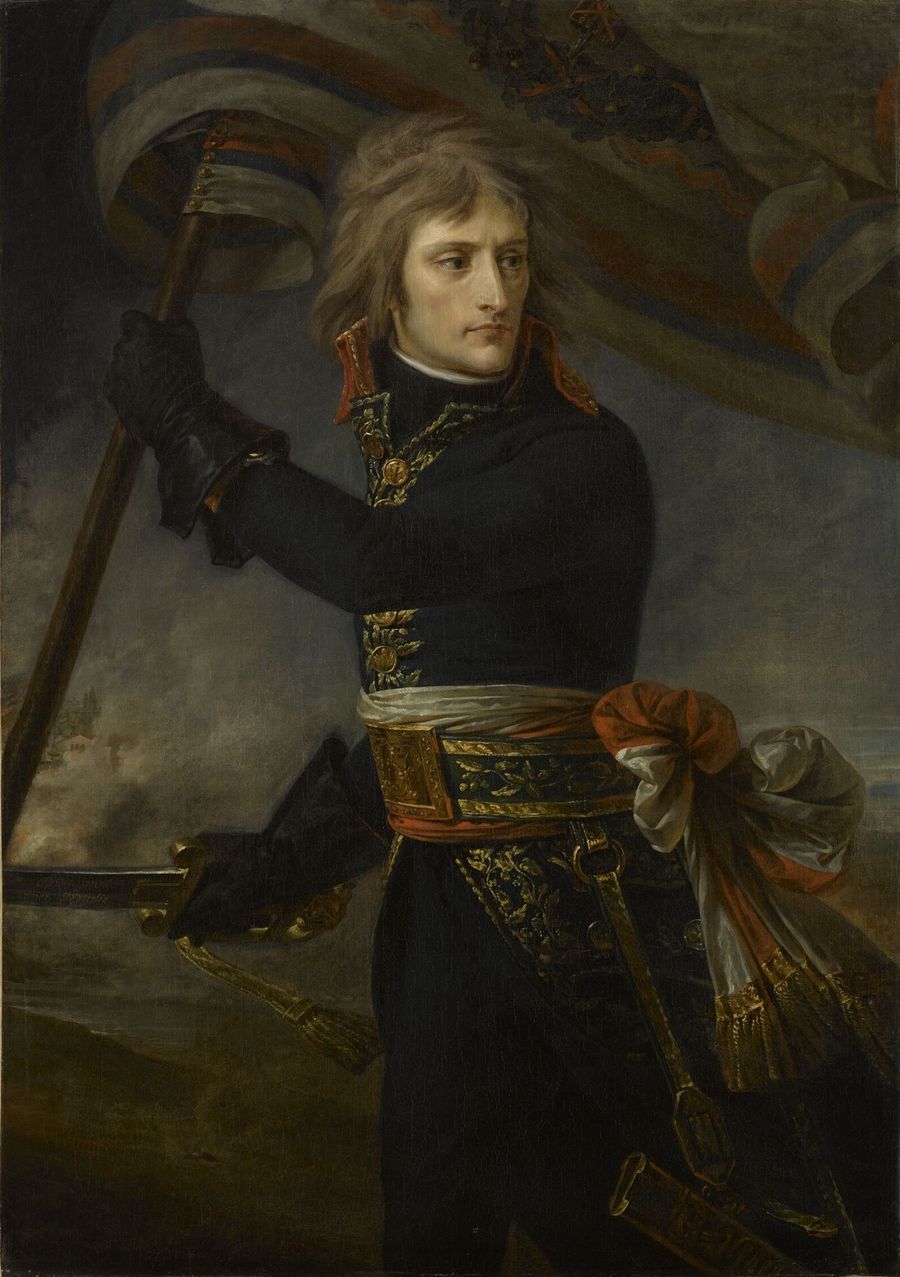
In March 1796 he married Joséphine de Beauharnais and, days later, took command of the poorly supplied Army of Italy. Within a year he defeated Austrian and Piedmontese armies in a run of fast battles — Lodi, Arcole, Rivoli — and imposed the Treaty of Campo Formio on Austria in October 1797. The campaign revealed what would become his signature: speed, concentration of force at the decisive point, and the use of bulletins and newspapers to build his image in Paris. Antoine-Jean Gros’s famous painting of him on the bridge at Arcole is an early example: a young commander charging with a flag through the smoke, closer to a political statement than to a record of events.
The Egypt and Syria campaign (1798–1801): what actually happened
After Italy, the Directory judged a direct invasion of Britain too risky, and Napoleon proposed striking British interests in the East by occupying Egypt, an Ottoman province ruled in practice by Mamluk beys. The fleet sailed from Toulon in May 1798, seized Malta on the way, and the army landed near Alexandria on 1 July 1798.
From Alexandria to Embaba
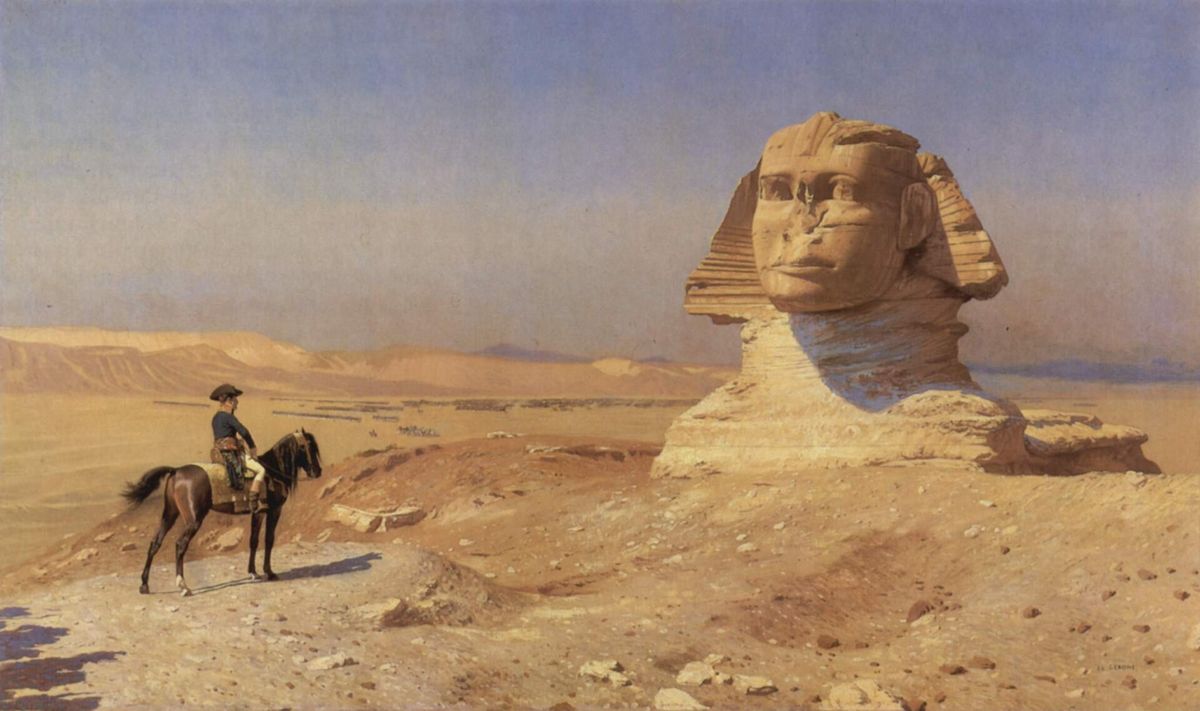
The army marched south across the desert in summer heat. On 21 July 1798 it met the Mamluk cavalry of Murad Bey near Embaba on the west bank of the Nile — the clash French propaganda named the “Battle of the Pyramids” because the pyramids were visible on the horizon. Infantry squares held against the cavalry charges, the Mamluks were defeated and the French entered Cairo. Only days later, on 1 August, the British fleet under Horatio Nelson destroyed most of the French fleet at anchor in Aboukir Bay. With that blow the French army was stranded in Egypt with no safe way home.
The Institute and the savants
What set this campaign apart was that it carried more than 150 scholars, engineers and artists, the Commission of Sciences and Arts. In August 1798 the Institut d’Égypte was founded in Cairo to study the country’s geography, antiquities, plants, animals and crafts. The result appeared later in the Description de l’Égypte, published between 1809 and 1829, which helped give birth to modern Egyptology. That scientific side cannot be separated from the military and colonial purpose of the expedition: knowledge was also gathered to administer an occupied country, a point many historians stress when weighing its legacy.
The Rosetta Stone: an accident that changed how we read the past
In July 1799, during fortification work near the town of Rashid (Rosetta) on the western branch of the Nile, French soldiers found a granodiorite slab inscribed in three scripts: hieroglyphic, Demotic and ancient Greek. The officer in charge realised the Greek text might unlock the other two. The stone did not stay in French hands: after the 1801 capitulation it passed to Britain under the surrender terms and has been displayed at the British Museum since 1802. In 1822 the French scholar Jean-François Champollion announced that he had deciphered hieroglyphs, using the stone and other texts. Its presence in London remains the subject of Egyptian calls for its return.
Cairo resists
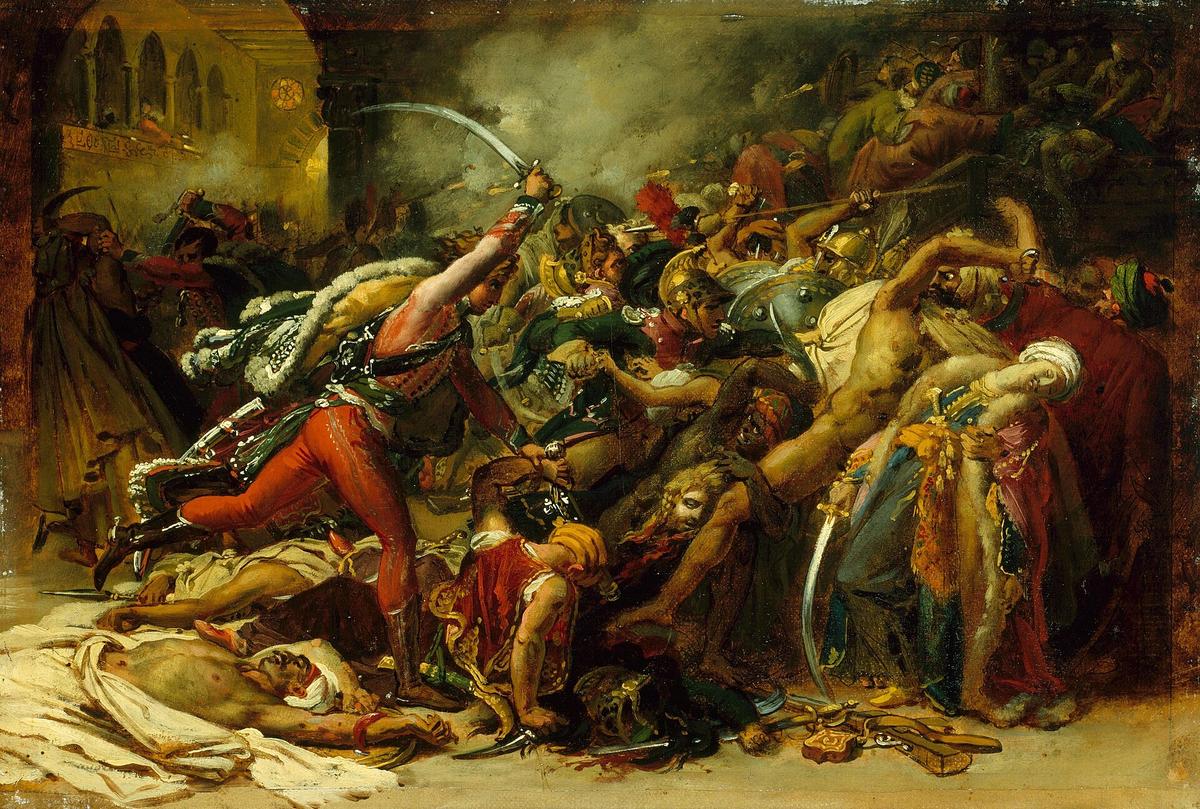
The French administration tried to win Egyptians over with proclamations promising respect for Islam and war on the Mamluks, and with a council of scholars and notables. But new taxes, demolitions, house searches and the humiliation of a foreign army sparked the first Cairo revolt in October 1798. Resistance spread from the quarters around al-Azhar; the French answered by shelling the area from the Citadel and the heights, then entered al-Azhar itself — an episode that remains in Egyptian memory as a symbol of the occupation’s brutality. A second uprising followed in the spring of 1800, after Napoleon had left.
The key Egyptian witness to these years is the historian Abd al-Rahman al-Jabarti, whose chronicle ‘Aja’ib al-Athar records daily life under occupation: his curiosity about French instruments and their library alongside his aversion to their conduct and policies. Reading al-Jabarti gives the campaign a local voice that balances the French narrative which dominated for so long.
Acre halts the advance
Early in 1799 Napoleon led his army into Syria to confront Ottoman forces preparing to move on Egypt. He took El-Arish, Gaza and Jaffa; at Jaffa a large number of prisoners were executed, an event historians agree took place while differing on its numbers and justifications. He then besieged Acre, defended by Ahmad Pasha al-Jazzar with support from British ships under Sidney Smith. The city held for about two months, plague spread among the troops, and Napoleon withdrew to Egypt in May 1799. In July he defeated an Ottoman force that had landed at Aboukir, before secretly leaving Egypt in August 1799 for France and handing command to General Jean-Baptiste Kléber.
The end: Kléber, Sulayman al-Halabi and withdrawal
Kléber faced an exhausted army and a second Cairo uprising, which he crushed. On 14 June 1800 he was assassinated by Sulayman al-Halabi, a student of al-Azhar from Aleppo, and General Jacques-François Menou took over. With British and Ottoman forces arriving in 1801, the French garrisons in Cairo and then Alexandria surrendered, and the last troops left in the autumn of 1801. Militarily the campaign failed, yet it left long questions: about the shock of contact with European technology, about the path Muhammad Ali Pasha took a few years later in building a modern state, and about the line between science and colonialism.
From First Consul to Emperor
Napoleon reached France in October 1799 as the Directory struggled with crisis and division. Weeks later, on 9 November 1799 (18 Brumaire in the revolutionary calendar), he took part in a coup that overthrew it. The new Consulate made him First Consul and the real holder of power. Over the next years he secured his rule with victory at Marengo in 1800, with the Concordat of 1801 that ended the conflict between the state and the Catholic Church, and with the short-lived Peace of Amiens with Britain in 1802.
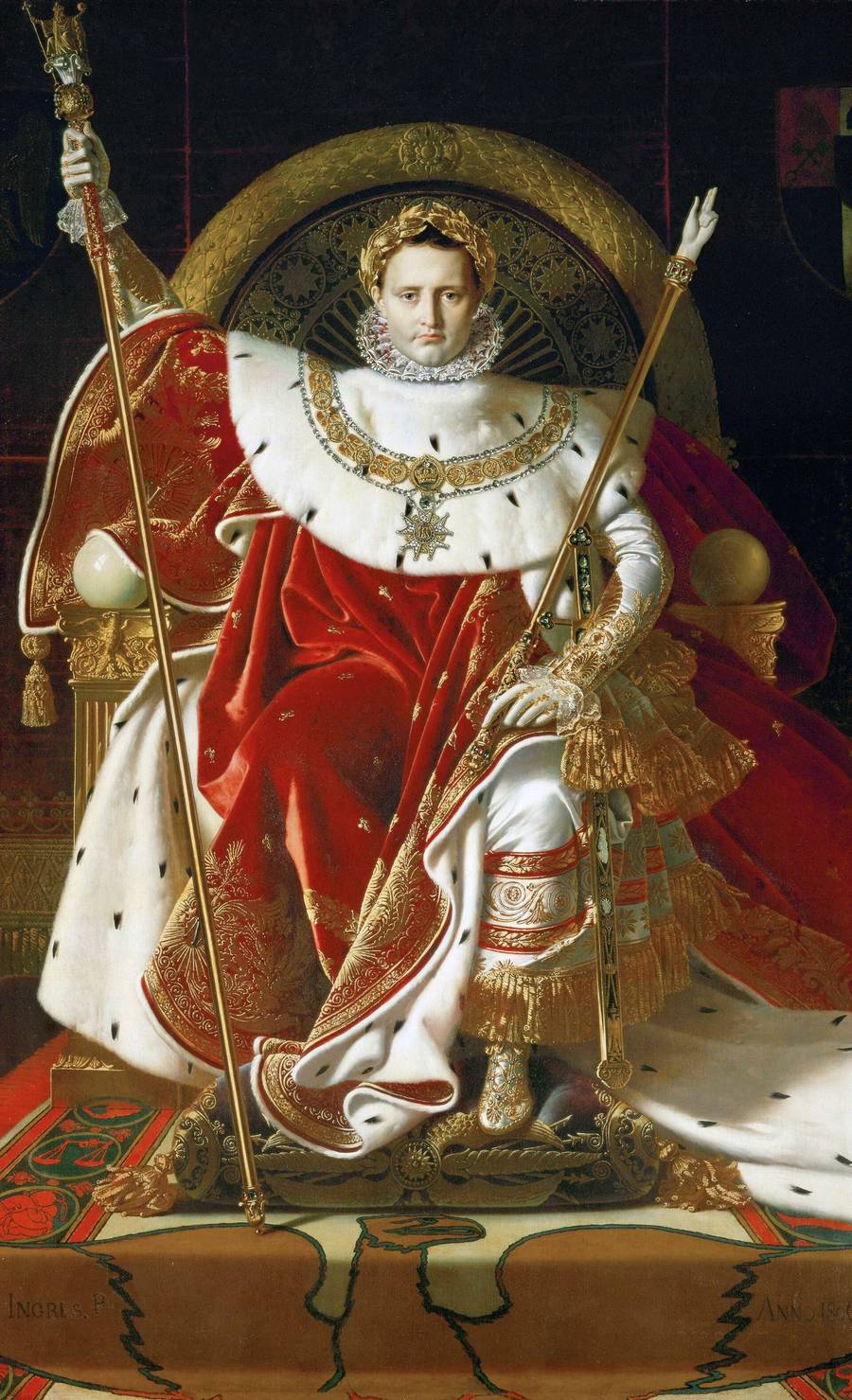
In 1802 a plebiscite made him Consul for life. He was proclaimed Emperor of the French in May 1804 and crowned in Notre-Dame de Paris on 2 December 1804 in the presence of Pope Pius VII, placing the crown on his own head. The new emperor rebuilt administration on strictly centralised lines: appointed prefects in the departments, the Banque de France founded in 1800, the lycée system and the Legion of Honour. Many of these institutions outlived him, which is why even his critics acknowledge his deep administrative impact.
The other side matters just as much: press censorship, political police and the shrinking of the freedoms the Revolution had proclaimed. In 1802 Napoleon restored slavery in the French colonies after the Revolution had abolished it in 1794, and sent an expedition to Saint-Domingue (Haiti) that ended in failure; the Haitian revolutionary leader Toussaint Louverture died in a French prison in 1803, and Haiti declared independence in 1804. This record in particular has become central to the debate over how France itself should remember him.
The Civil Code: the longest-lived legacy
Ask historians what Napoleon left that lasted longest and many will point to the Civil Code of the French, promulgated on 21 March 1804 and later known as the Napoleonic Code. He did not write it alone — a commission of senior jurists drafted it — but he attended many of the debating sessions and pushed it to completion. The code merged customs and laws that varied from region to region into one clear text and set down principles such as equality before the law, protection of private property, freedom of contract and the civil nature of marriage and records.
The code travelled with French armies to Belgium, Luxembourg and parts of Italy, Germany and the Netherlands, then became a model for many states in Europe and Latin America. In the Arab world, the Egyptian civil codes drawn up for the Mixed Courts in 1875 and the National Courts in 1883 were clearly shaped by French law, an influence that later spread through Egyptian civil law to other Arab legislation. Yet the code was not progressive in everything: it entrenched a husband’s authority over his wife and limited women’s rights to own property and go to court, and many of those articles were reformed only in the twentieth century.

Three battles that sum up the rise and fall
Austerlitz, 1805: the height of military genius
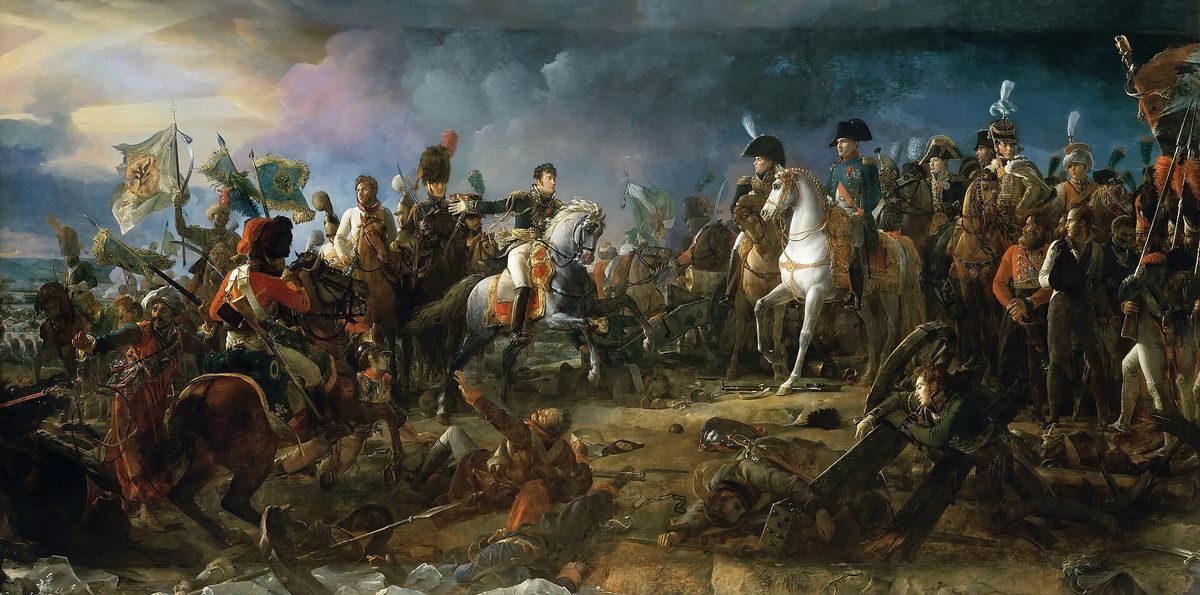
On 2 December 1805, the first anniversary of his coronation, Napoleon faced the Austrian and Russian armies near Austerlitz in Moravia (today’s Czech Republic) in what became known as the Battle of the Three Emperors. He deliberately made his right wing look weak to lure the allies into attacking it, then struck their centre once they had thinned it by shifting troops, splitting their lines for a decisive victory. Military academies still teach it as a lesson in deception and timing. Yet six weeks earlier the British fleet had crushed the French and Spanish fleets at Trafalgar, so Napoleon became master of the European continent while the seas stayed British — an equation that governed the rest of his wars.
Victories followed at Jena and Auerstedt against Prussia in 1806 and at Friedland in 1807, then the Peace of Tilsit with Russia. Napoleon tried to strangle Britain’s economy with the Continental System, which banned trade with Britain, but enforcing it hurt his allies too and pushed him into new interventions, above all the long war in Spain and Portugal from 1808 that drained his army for years.
Russia, 1812: the catastrophe
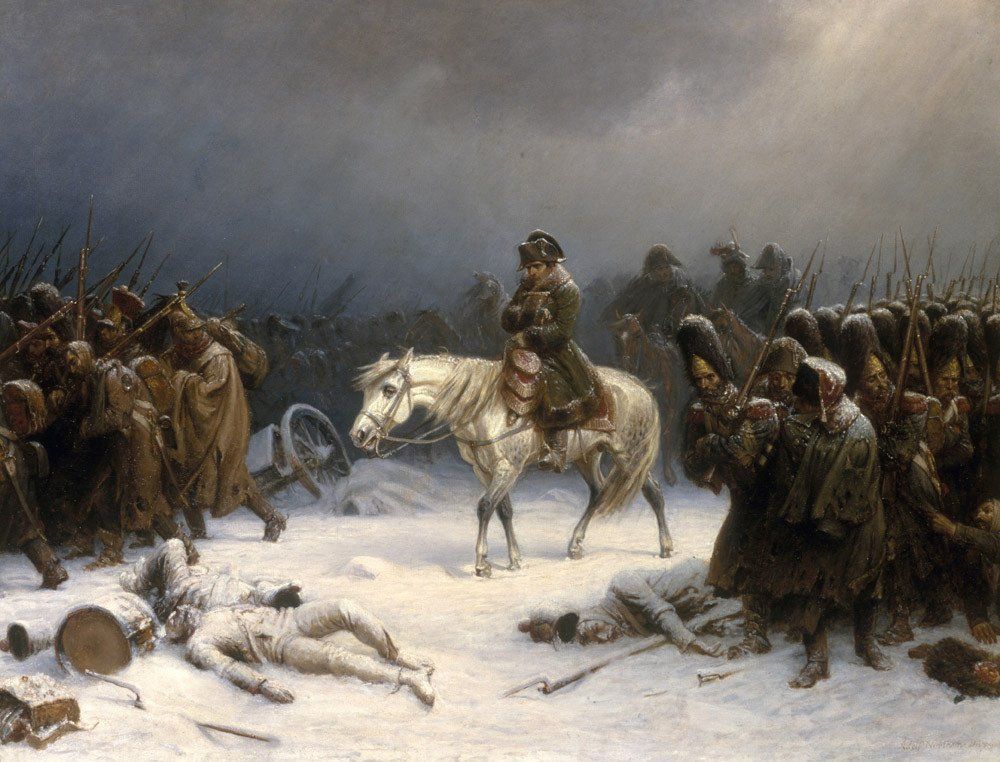
When Russia left the Continental System, Napoleon decided to invade. He crossed the Niemen in June 1812 with a huge multinational army, estimated at anywhere from more than 400,000 to around 600,000 men depending on how it is counted. The Russians avoided a decisive battle and withdrew inland until the bloody battle of Borodino on 7 September. Napoleon entered Moscow on 14 September to find it largely empty, and fires soon consumed much of the city. He waited for a peace offer that never came and began the retreat in October. Cold, hunger, Cossack raids and the tragic crossing of the Berezina in November left only a small fraction of the army. Historians agree the campaign was the turning point that encouraged Europe to unite against him.
Waterloo, 1815: the last chapter
After defeat at the Battle of the Nations near Leipzig in October 1813, the allies entered Paris; Napoleon abdicated in April 1814 and was exiled to Elba off the Italian coast. He stunned Europe by returning to France in March 1815, winning over the troops sent to arrest him and regaining power for the Hundred Days. On 18 June 1815 he fought his last battle near Waterloo in Belgium against the army commanded by the Duke of Wellington; Prussian forces under Blücher arrived at the decisive moment in the afternoon and turned the battle. The French army was defeated and Napoleon abdicated a second time days later.
Exile and death on St Helena
Napoleon surrendered to the British, who this time sent him to the remote island of St Helena in the South Atlantic, thousands of kilometres from Europe. He arrived in October 1815 and lived at Longwood House with a small group of companions, dictating memoirs that were published later and helped shape his image as a hero of the Revolution wronged by Europe’s kings.
He died on 5 May 1821, aged fifty-one. The autopsy report pointed to advanced disease of the stomach, and most historians and modern physicians favour stomach cancer as the cause of death. A twentieth-century theory of arsenic poisoning based on analyses of his hair gained popularity, but later studies showed arsenic was common in the environment of the time, and the theory has never been proven. In 1840 his remains were brought back to Paris in a grand procession; he now lies beneath the dome of Les Invalides.
A contested legacy and common myths
The height myth
One of the most repeated claims is that Napoleon was very short. His height at death was recorded as five feet two inches in old French units, equal to roughly 168–169 cm — about average for a Frenchman of his time, or slightly above. The confusion comes from the difference between French and English inches, from British caricatures that drew him as a furious dwarf, from the affectionate nickname “the little corporal” used by his soldiers, and from the fact that he was often surrounded by tall guardsmen.
Hero or tyrant?
Admirers argue that he rescued the Revolution’s gains from chaos, entrenched equality before the law, opened careers to talent rather than birth and founded institutions that still function. Critics argue that he unleashed continuous wars that cost Europe millions of lives — common estimates for the dead of the Napoleonic Wars range from three to six million soldiers and civilians — restored slavery, suppressed freedoms and treated occupied peoples as a source of soldiers and money. In 2021, the bicentenary of his death, the French themselves were divided over how to mark it, proof that the question is far from settled.
The image he made of himself
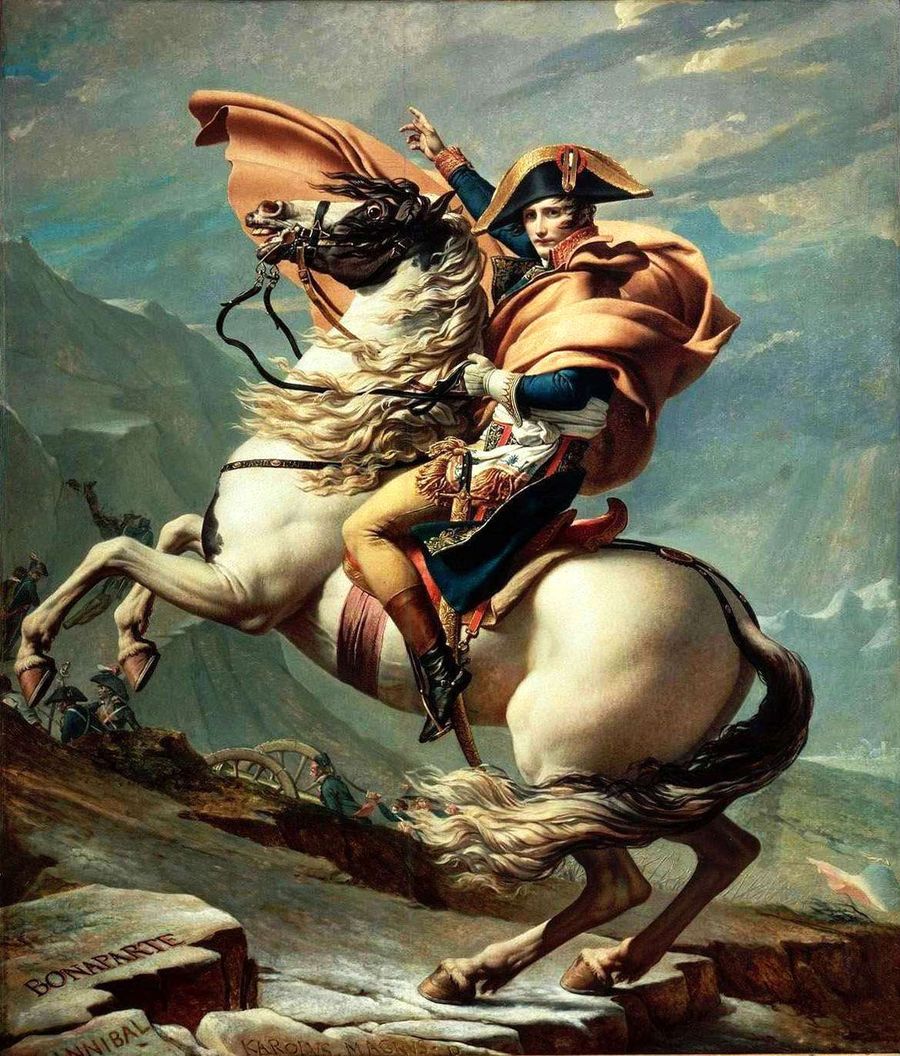
Napoleon was one of the first rulers to grasp the power of image and modern propaganda. He issued army bulletins, supervised official paintings and steered artists to show him as a calm commander on a rearing horse, as in Jacques-Louis David’s Napoleon Crossing the Alps, even though accounts from the period say he crossed the Great St Bernard Pass on a mule in calm weather. The paintings that accompany this article should therefore be read as documents of how he wanted to be seen, not as photographs of events.
Short timeline
- 1769 Born in Ajaccio, Corsica, a year after the island passed to France.
- 1785 Graduates as an artillery officer from the École Militaire in Paris.
- 1793 Siege of Toulon; promoted to brigadier general.
- 1795 Puts down a royalist rising in Paris (13 Vendémiaire).
- 1796–1797 Italian campaign; Treaty of Campo Formio with Austria.
- 1798 Landing at Alexandria, battle at Embaba (“the Pyramids”), fleet destroyed at Aboukir Bay, Institut d’Égypte founded, first Cairo revolt.
- 1799 Rosetta Stone found; siege of Acre fails; return to France and the coup of 18 Brumaire.
- 1800 Victory at Marengo; Kléber assassinated in Cairo.
- 1801 Concordat with the Church; French forces leave Egypt.
- 1802 Consul for life; slavery restored in the colonies.
- 1804 Civil Code promulgated; crowned emperor at Notre-Dame.
- 1805 Defeat at Trafalgar; victory at Austerlitz.
- 1806–1807 Jena–Auerstedt, Continental System, Friedland and the Peace of Tilsit.
- 1808 Start of the long war in Spain and Portugal.
- 1810 Marriage to Marie-Louise of Austria.
- 1812 Invasion of Russia and catastrophic retreat.
- 1813 Defeat at the Battle of the Nations near Leipzig.
- 1814 First abdication; exile to Elba.
- 1815 The Hundred Days, Waterloo, exile to Saint Helena.
- 1821 Death on Saint Helena.
- 1822 Champollion announces the decipherment of hieroglyphs.
- 1840 Remains returned to Paris.
How should we read Napoleon today?
The fairest way to understand Napoleon is to put achievement and cost on the same scale. The man who organised the Civil Code and founded schools and a central bank is the same man who led hundreds of thousands into the Russian snow, restored slavery and turned cannon on the quarters of Cairo. For Arab readers, the Egypt and Syria campaign remains an important entry point into the beginnings of the modern relationship between the Arab East and Europe: a moment when scientific discovery and military occupation were entangled, and from which questions about renaissance and modernisation emerged that still echo today. Reading him critically does not mean denying his genius; it means not letting the legend write history in our place.
Frequently asked questions
Was Napoleon really short?
No. His height at death corresponds to about 168–169 cm in modern units, roughly average for a Frenchman of his time. The myth grew from the difference between French and English inches, British caricatures and the nickname “the little corporal”.
Why did Napoleon go to Egypt?
To strike British interests in the East and threaten the route to India, after the Directory judged a direct invasion of Britain too risky — together with Napoleon’s personal ambition and the idea of a lasting French foothold in the region.
Who found the Rosetta Stone and where is it now?
French soldiers found it in July 1799 during fortification work near Rashid (Rosetta). It passed to Britain under the 1801 surrender terms and has been displayed at the British Museum since 1802; Egyptian voices continue to call for its return.
What is the Napoleonic Code?
The French Civil Code promulgated on 21 March 1804. It unified local customs into one text and set out equality before the law, private property and freedom of contract, influencing many legal systems including Egypt’s nineteenth-century civil codes.
How did Napoleon die?
He died on Saint Helena on 5 May 1821, aged 51. Most historians and physicians favour stomach cancer, based on the autopsy report; the arsenic-poisoning theory has never been proven.
Where is Napoleon buried?
First on Saint Helena; his remains were brought to Paris in 1840 and now lie beneath the dome of Les Invalides.
Sources and further reading
This article is written in Vemetto’s own words and does not reproduce text from these works; they are listed for verification and further reading. No quotations are attributed to anyone.
- Abd al-Rahman al-Jabarti, ‘Aja’ib al-Athar fi al-Tarajim wa al-Akhbar — the leading Egyptian eyewitness chronicle of the occupation.
- Description de l’Égypte, published 1809–1829 — the encyclopaedic work of the expedition’s savants.
- Juan Cole, Napoleon’s Egypt: Invading the Middle East (2007).
- Andrew Roberts, Napoleon the Great (2014).
- Philip Dwyer, three-volume biography (Napoleon: The Path to Power, Citizen Emperor, Napoleon: Passion, Death and Resurrection).
- Steven Englund, Napoleon: A Political Life (2004).
- David G. Chandler, The Campaigns of Napoleon (1966).
- Adam Zamoyski, 1812: Napoleon’s Fatal March on Moscow (2004).
- Sudhir Hazareesingh, The Legend of Napoleon (2004).
About the images
All paintings shown here are public-domain artworks (their painters died more than a century ago); their digital copies are published on Wikimedia Commons under a “public domain” licence and are self-hosted here after compression. The image marked “Illustrative image” was generated for Vemetto and does not depict a real document.